5 signs you’re lacking visibility into cloud security
How to detect invisible risks before they become problems or compliance breaches for your company
Cloud security is a priority for every business. However, as infrastructures grow and become more complex, the difficulty of seeing and controlling what happens within them also increases.
Today, it’s common to operate across multiple cloud environments, with interconnected services, reliance on various external providers, and teams working simultaneously on the infrastructure.
In this scenario, the problem is often no longer a lack of security tools.
The problem is a lack of visibility.
Many organizations have monitoring systems, security solutions, and control mechanisms in place, yet they still struggle to answer key questions:
- Who made this change?
- Why did this anomaly appear?
- Which systems are affected?
- Are we meeting the security and compliance requirements for the standards that matter to us?
- Could we detect an issue before it negatively impacts the business?
When these questions don’t have easy, clear answers, there are usually blind spots within the security strategy.
Here are some of the most common signs.
1. You discover problems only after they've already caused impact and/or losses
One of the clearest indicators of poor visibility is discovering incidents only when users are already affected or when the issue has escalated.
This could involve unauthorized access, misconfigurations, exposed resources, or anomalous behavior within an application.
When detection comes too late, the window for action is much narrower, and the business impact is typically greater.
Modern security is no longer just about reacting—it’s about identifying early signals that allow you to act before a risk turns into a problem.
2. You receive so many alerts that it's hard to distinguish what's important
As an infrastructure grows, so does the volume of alerts and notifications received by teams.
The problem arises when hundreds or even thousands of warnings are generated every day.
In that scenario, several things tend to happen:
- Repeated alerts
- Notifications that don’t actually require action
- Information scattered across different tools
- Overwhelmed teams reviewing incidents unnecessarily
When everything seems urgent, it becomes much harder to identify what truly needs attention and prioritization.
That’s why more and more companies are looking for ways to automatically prioritize information and reduce operational noise.
3. You're not clear on what changes have been made to the infrastructure
Cloud environments are constantly evolving.
New services are created, configurations are updated, permissions are modified, and new applications are continuously integrated.
Without traceability, it’s difficult to answer even simple questions like:
- What changed?
- When did it happen?
- Who made the modification?
- What impact might it have?
Having this information not only helps improve security but also reduces errors and accelerates incident resolution.
4. Audits are still a long and complex process
Many organizations still spend weeks gathering evidence to demonstrate regulatory compliance.
Searching through logs, reviewing documentation, and compiling information often becomes additional work for technical teams.
However, when there’s a solid strategy for observability, security, and compliance, much of that information is already available and centralized.
This facilitates compliance with standards and regulations such as:
- ISO 27001
- ENS (Spanish National Security Framework)
- NIS2
- GDPR
- SOC 2
In addition to saving time, it also reduces the risk of errors and brings greater peace of mind during audits.
5. Security, operations, and compliance work in silos
Another common symptom appears when each team uses different tools and works with different information.
When each area operates in isolation, it becomes harder to have a complete view of what’s happening.
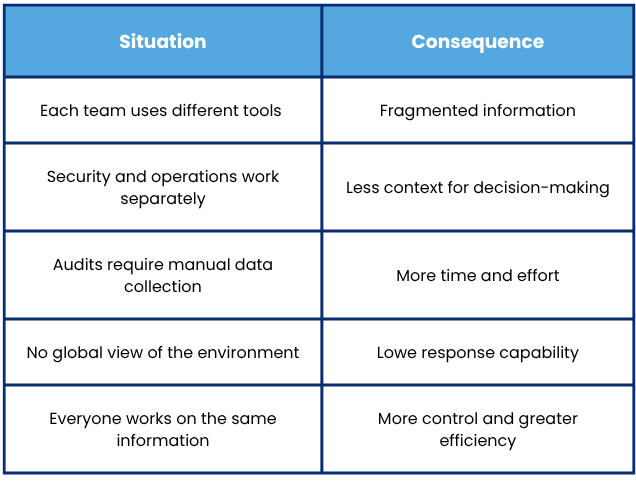
Security is far more effective when all areas share context and visibility.
Why SecOps is becoming increasingly important
As infrastructures become more complex, security is no longer the sole responsibility of a single team.
This is where SecOps (Security Operations) comes in—an approach that brings security and operations together, enabling teams to work from a shared view of the system.
The goal is to detect earlier, respond faster, and reduce risks without slowing down business activity.
It’s not about adding more tools—it’s about making sure the right information reaches the right people at the right time.
Conclusion
Most security problems don’t arise because tools are missing.
They often arise because blind spots make it difficult to understand what’s really happening within the infrastructure.
If alerts are excessive, if it’s difficult to identify changes, if audits remain a manual process, or if you struggle to react in time to potential risks, the challenge probably isn’t security itself—it’s a lack of visibility.
How Lessthan3 can help
At Lessthan3, we help companies improve visibility into their cloud environments by combining advanced observability, AI-powered predictive capabilities, and features focused on security and compliance.
Our platform enables you to analyze metrics, logs, traces, and events in real time to detect anomalous behavior, correlate information from different systems, and deliver useful context from the very first moment.
And in a cloud environment where everything changes constantly, having that visibility is what allows you to operate with greater confidence, meet regulatory requirements, and protect business growth.
With the Lessthan3 platform, companies can take that step and turn security into a smarter, more connected, and more proactive process.