How to automate without chaos? The DevOps best practices no one told you about
From chaos to control: intelligent automation with a DevOps approach.
The challenge of scaling without losing control
IT process automation is one of the great promises of digital transformation. It reduces errors, speeds up delivery times, and frees up the technical team for more strategic tasks. But if done without control, it can lead to opaque infrastructures, security issues, and unexpected costs. In this context, automating – but doing so intelligently- becomes the new standard.
According to a McKinsey & Company study, automation combined with artificial intelligence could contribute to labor productivity growth between 0.1% and 0.6% annually until 2040, depending on the rate of adoption.
Why automate IT processes?
Automation is not a trend: it is a necessity for any company that aspires to scale and remain competitive.
When done correctly, an organization can:
- Reduce repetitive manual tasks, freeing up time for innovation.
- Minimize human error, thanks to defined and consistent processes.
- Streamline deployments and updates, shortening delivery cycles.
- Increase availability and response time, with automatic detection and reaction.
- Improve the traceability of every action, leaving an auditable record of each change.
Companies that successfully automate their IT processes often see an immediate improvement in their operational efficiency and system stability.
Which processes to automate first?
Automating everything at once is a recipe for chaos. The recommended approach is to start with processes that are high-frequency, low-risk, and have a high impact when automated correctly.
Common examples:
- CI/CD (continuous integration and continuous delivery) deployments.
- Infrastructure provisioning (Infrastructure as Code).
- Automated and verified backups.
- User and permission management.
- Automatic alerts and escalations for failures or incidents.
Each automation should be evaluated based on its technical ROI: how much time and how many errors it saves versus its implementation complexity.
Key automation tools
There are multiple tools on the market, and the choice depends on the tech stack, the team’s maturity, and business objectives.
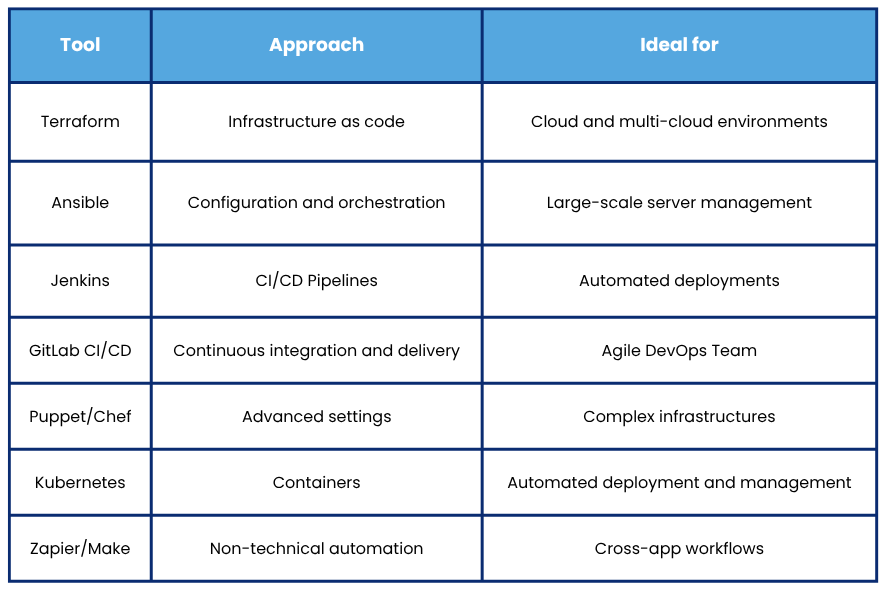
Each one covers a different layer of automation, from infrastructure to business processes.
How to Avoid Losing Traceability
Automating does not mean losing control. Traceability is what turns automation into a responsible and sustainable practice.
To maintain it, apply these recommendations:
- Document every automated process. Studies show that good documentation increases the reliability of the automated system.
- Centralize logs and records, so any team member can audit changes.
- Implement role-based permissions, preventing accidental or unauthorized modifications.
- Associate every change with an official review or request, for example, through pull requests or change tickets.
- Continuously monitor the results and adjust the rules based on metrics.
DevOps Best Practices (the ones no one told you about)
The “best practices” are what make the difference between automation that frees the team and one that overwhelms it.
Here are some that we at Lessthan3 apply and recommend:
1. Involve development and operations teams from the start.
Automation must align with business objectives, not just technical ones. A coordinated team avoids duplication and conflicts.
2. Automate in small steps and validate each advance.
Gradual changes allow you to detect before they spread. Start with simple, low-risk tasks.
3. Measure the impact of each automation.
Define success metrics: deployment time, reduction in incidents, hours saved, etc. What isn’t measured, cannot be improved.
4. Use sandbox or staging environments to experiment without fear.
A safe testing environment prevents surprises in production and fosters a culture of continuous learning.
5. Create clear and actionable alerts.
An alert that no one understands is useless. Prioritize clarity and relevance: notifications should indicate what to do and who should do it.
6. Audit your automations periodically.
Needs change. Reviewing scripts, permissions, and flows ensures they remain useful, secure, and efficient.
How Lessthan3 Helps Implement Responsible Automation
At Lessthan3, we believe that automation is not just about technology, but also about methodology and strategy.
That’s why we support companies throughout the entire process:
- We analyze your current processes and identify improvement opportunities.
- We propose progressive and secure automation, with a clear roadmap.
- We train your team to maintain and scale systems autonomously.
- We design tailored solutions that respect your business rules and control levels.
Automation is not about turning off the human pilot, but turning them into a strategic copilot who directs with precision and visibility.
Conclusión
Responsible automation not only drives efficiency but also improves resilience and transparency.
With the right best practices, every automated process becomes an opportunity to innovate without sacrificing control.
Automation is not about eliminating the human factor, but empowering it with the right tools.