Latency, errors, and saturation: 3 warning signs before an outage
How to detect problems before they affect the service
A service outage rarely appears without warning. In many cases, the infrastructure begins to show signs that something isn’t working correctly: applications take longer to respond, errors increase, or available resources start running short.
The problem is that these signals aren’t always interpreted in time. Detecting them and understanding what’s causing them allows you to anticipate bigger failures and reduce their impact.
There are three especially useful indicators for this: latency, errors, and saturation.
1. Latency: when services start responding more slowly
Latency is the time it takes for a system to respond to a request. When it increases, users may notice that a page takes longer to load, an operation is delayed, or an application responds slowly.
A one-off increase doesn’t always indicate a serious problem. However, if response times grow continuously, it can be a sign that something is affecting performance.
Possible causes include:
- Server overload.
- Database queries that are too slow.
- Communication problems between services.
- Insufficient resources to handle requests.
For example, if an online store starts taking several seconds longer to display its products, it may be experiencing a performance problem that, if not identified, could end up affecting the checkout process and, without a doubt, the customer experience.
2. Errors: when operations start failing
An increase in errors is another important signal. It may manifest through requests that don’t complete, failed responses, or features that become unavailable.
Not all errors have the same origin or the same consequences. Some are one-off, while others may indicate a problem affecting different infrastructure components.
It’s worth paying attention to situations such as:
- An increase in HTTP 5xx responses.
- Recurring request failures.
- Connection errors between services.
- Operations that don’t complete.
For example, if an application starts logging errors when querying a database, other features that depend on it may also be affected.
Analyzing errors and relating them to other indicators helps find their origin before the problem spreads.
3. Saturation: when resources approach their limit
Saturation occurs when a system’s resources are used to the point of hindering normal operation.
It can affect CPU, memory, storage, or the capacity to handle requests. When a resource approaches its limit, the system may start responding more slowly or generating errors.
Some common signals are:
- High and sustained CPU usage.
- Increasingly limited available memory.
- Growing request queues.
- Storage resources nearing capacity.
Let’s imagine an application receives a traffic spike. If its servers can’t process all the requests, requests will start piling up and response times will increase.
That’s why detecting saturation before reaching the capacity limit allows you to act in advance.
Why is it important to analyze all three signals together?
Latency, errors, and saturation shouldn’t always be analyzed separately. In many cases, they’re related and part of the same problem.
For example, a server may start using too much CPU. As a result, response time increases and some requests end up failing.
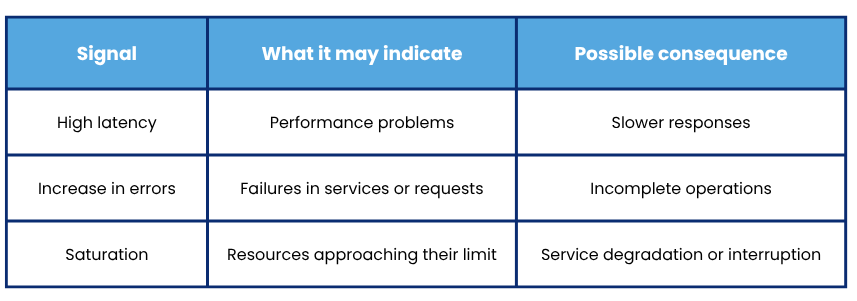
Relating these signals allows you to better understand what’s happening and distinguish an isolated symptom from a problem that could end up causing an outage.
How does Korai help anticipate problems?
Korai, Lessthan3’s observability and artificial intelligence platform, brings together metrics, logs, traces, and events to offer a connected view of infrastructure behavior.
Its capabilities help detect anomalies, correlate signals, and understand how the different components of a cloud environment relate to each other.
Anticipating is better than reacting
An outage can be the result of several problems that have been appearing progressively. That’s why monitoring latency, errors, and saturation is essential for knowing the real state of an infrastructure.
Detecting the first signals, relating them, and understanding their origin allows you to make decisions before the impact reaches users and affects the business.
With Korai, teams have more context to understand what’s happening in their infrastructure and move from reacting to outages to anticipating problems.