Incidents: how to measure their impact
How to identify the severity of a problem and prioritize its resolution
In a cloud infrastructure, not all problems have the same consequences. An application may respond more slowly than usual, while a failure in a critical service can interrupt a company’s operations, preventing it from continuing its activity and/or generating revenue.
In both cases there is an incident, but its impact and the urgency of resolving it are very different.
That’s why detecting a problem is only the first step: you also need to understand its consequences and decide what to address first.
What is an incident?
An incident is any problem that interrupts, degrades, or prevents the expected functioning of a service, an application, or an infrastructure component.
It may be a complete outage, an increase in errors, slower response times, or a service that starts behaving irregularly.
Not all incidents cause a visible interruption. Some progressively degrade performance and affect users before the technical team detects their origin.
What determines the impact of an incident?
The severity of a problem depends on the affected service, the number of users impacted, and the consequences for the business in economic or reputational terms.
For example, a one-off slowdown in an internal tool doesn’t have the same impact as a failure in the payment system of an online store.
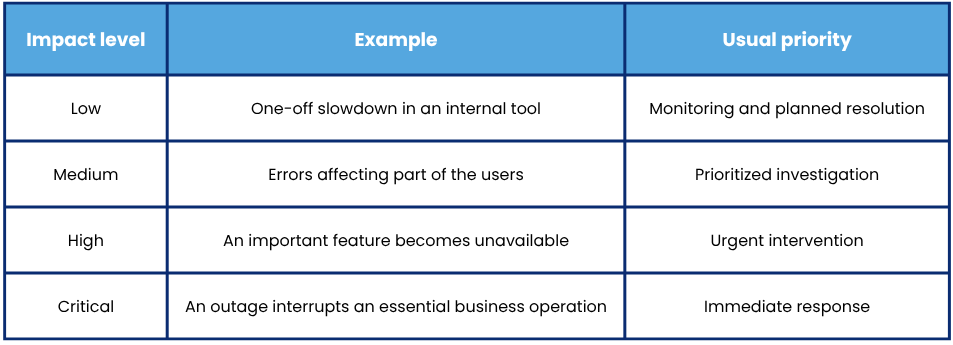
This classification is indicative: each organization should establish its own criteria based on its services and needs.
Priority should not depend solely on the alert received, but on the real consequences of the problem.
The challenge of distinguishing the urgent from the important
In complex cloud environments, a single incident can generate numerous alerts. A service starts responding slowly, wait times increase, and other components begin to fail.
Without context, these signals may appear to be independent problems and make it difficult to identify what requires immediate attention.
That’s why correlating alerts and analyzing different sources of information is essential for prioritizing correctly. Metrics show how the infrastructure is behaving; logs provide details about errors; and traces allow you to follow the journey of requests between services.
How does Lessthan3 help manage incidents?
The Lessthan3 platform brings together metrics, logs, and traces in a single environment to offer a complete view of what’s happening in the cloud.
Thanks to its observability and artificial intelligence capabilities, it allows you to detect anomalies, correlate signals, and better understand the behavior of services. In addition, the Trace Explainer feature helps interpret what happened and understand the operational impact, while Troubleshooter offers recommendations to guide resolution.
This way, teams can move from receiving isolated alerts to having more context to decide where to act first, reduce investigation time, and prevent problems from getting worse.
Resolving better starts with prioritizing
Not all incidents require the same response. Some can wait; others need immediate intervention to prevent the impact from growing.
Knowing what’s failing, who it affects, and what consequences it may have is essential for making better decisions.
With Lessthan3, teams have a more connected view of their infrastructure to understand incidents and focus their efforts on the problems that really matter.