How to eliminate alert noise in DevOps teams with AI
Fewer alerts, more context: helping teams focus on what matters
In every DevOps team, there comes a point when the problem is no longer a lack of information—it’s quite the opposite: too many alerts.
Every infrastructure change, every traffic spike, or every slight deviation from normal behavior can trigger dozens of notifications. The result? Teams receive hundreds or even thousands of alerts per day, many of them redundant, barely relevant, or lacking the context needed to determine whether they actually require attention.
And when everything seems urgent, distinguishing a critical issue from a simple anomaly stops being a straightforward task.
This is where AI-powered observability is transforming how teams operate. It’s no longer just about generating alerts—it’s about understanding which ones truly matter.
The problem isn't receiving alerts—it's receiving too many
Traditional monitoring tools do their job well: detecting events when certain metrics exceed predefined thresholds.
The challenge arises as infrastructure scales.
More applications, more microservices, more containers, more integrations, and more teams inevitably generate more events. And often, a single issue triggers dozens of different alerts.
This leads to common situations like:
- Duplicate alerts for the same incident
- Notifications that don’t actually require intervention
- Teams manually reviewing information from multiple tools
- Alert fatigue
- The risk of a major incident going unnoticed
The problem is no longer detecting incidents.
The problem is identifying which ones truly need attention.
What is alert noise?
Alert noise refers to the collection of notifications that provide no useful information or make it difficult to quickly identify a real problem.
It doesn’t mean the alerts are incorrect.
It simply means they arrive without sufficient context or appear in isolation, forcing teams to manually investigate what’s happening.
The higher the volume of alerts, the more time teams spend analyzing them—and the less time they have to resolve issues that genuinely impact the business, or even to do the DevOps work that improves and evolves the existing infrastructure.
Why does this happen in modern cloud environments?
Today’s infrastructures are far more dynamic than they were just a few years ago.
A single request can pass through multiple services, APIs, databases, serverless functions, or external providers before completing.
When a failure occurs, all those components can generate alerts simultaneously.
Without a way to correlate them, teams receive a massive amount of fragmented information.
And the more complex the architecture, the greater that operational noise tends to be.
How AI helps reduce operational noise
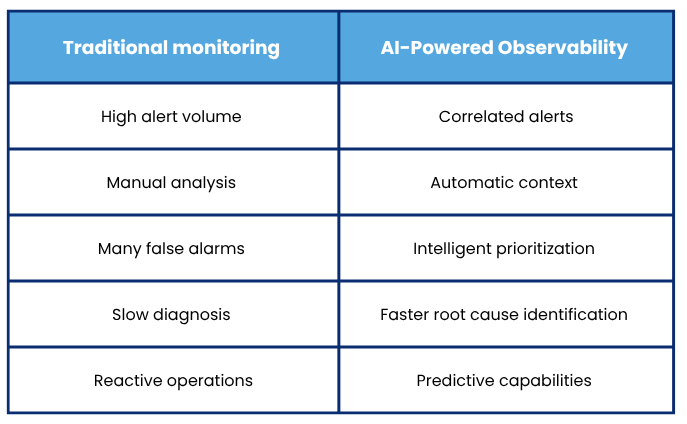
The difference between traditional monitoring and an AI-driven observability strategy isn’t about generating more alerts.
It’s about making them much smarter.
Artificial intelligence continuously analyzes metrics, logs, traces, and events to find relationships between them.
Instead of displaying hundreds of standalone notifications, it can:
- Correlate related events
- Automatically detect anomalies
- Prioritize incidents based on their impact
- Identify potential root causes
- Reduce duplicate or irrelevant alerts
- Provide context to accelerate decision-making
The result is far more useful for teams: less noise and more actionable information.
Traditional monitoring vs. AI-powered observability
The impact on DevOps teams
Reducing alert noise doesn’t just improve technical operations—it changes how teams work.
When teams stop constantly reviewing irrelevant notifications:
- They spend more time on high-value tasks
- Diagnosis time decreases
- MTTR improves
- Operational fatigue is reduced
- Incidents are resolved faster
- Decisions are made with greater confidence
In other words, AI doesn’t replace the team—it eliminates much of the repetitive work that consumes time every day.
A simple example
Imagine an e-commerce platform during a high-traffic campaign.
Suddenly, response times increase and dozens of alerts start coming in from various services.
Without AI, the team must review dashboards, logs, and metrics to figure out whether all those alerts stem from one issue or several different ones.
With an AI-powered observability platform, the system automatically detects that all alerts are related to a single incident, identifies which service is causing the degradation, and prioritizes action before the impact grows.
The difference isn’t just resolving faster.
It’s understanding what’s happening sooner, so you can act correctly.
How Lessthan3 helps
At Lessthan3, we help companies reduce the operational noise generated by alerts with our AI-powered platform.
It continuously analyzes metrics, logs, traces, and events to correlate alerts, detect anomalies, and provide context from the very first moment.
This way, teams can focus on resolving incidents that truly matter—rather than spending time reviewing hundreds of unrelated notifications.
Because the more complex a cloud infrastructure becomes, the more critical it is to distinguish noise from information that actually delivers value.
Conclusion
In today’s cloud environments, alert overload can become just as significant a problem as the incidents themselves.
It’s not about receiving more information—it’s about receiving the right information at the right time.
Reducing operational noise allows DevOps teams to work more efficiently, respond to incidents sooner, and maintain control even as infrastructure complexity continues to grow.
With Lessthan3’s platform—combining advanced observability and artificial intelligence—companies can transform thousands of alerts into useful information to make better decisions and operate with far greater confidence.