Smart FinOps: How to Control and Optimize Cloud Spending
Stop seeing your cloud bill as a problem and start using it to make better decisions
For a long time, optimizing cloud spend was understood simply as reducing costs. However, that perspective falls short in a context where infrastructures are increasingly dynamic, resources are constantly changing, and business needs evolve at breakneck speed.
Today, the real challenge isn’t spending less—it’s spending smarter.
Many companies know the total amount of their monthly bill, but they don’t always know which services are consuming the most resources, which teams are generating that spend, or whether the investment is delivering the expected value. Without that context, optimizing investment becomes an exercise in trial and error.
This is where FinOps comes into play—a methodology that helps align technology, operations, and business to make investment and procurement decisions based on data, achieving a much more efficient use of the cloud.
What is FinOps?
FinOps (Financial Operations) is a way of managing cloud consumption based on collaboration between technical, financial, and business teams.
Its goal isn’t to limit the use of the cloud or technology infrastructure, but rather to ensure that every euro invested in this area delivers maximum value to both technical and business teams.
This means answering questions like:
- Which services generate the most spend?
- Is that consumption truly justified and delivering value?
- Are there underutilized resources that can be decommissioned?
- Where are the optimization opportunities?
- How will a new project impact the budget or cloud bill?
When all these questions have answers, decisions made by a CTO, CIO, or Head of Engineering are no longer based on intuition—they’re backed by real information.
The problem isn't usually the spend—it's the lack of context
Receiving a high cloud bill doesn’t always mean there’s a problem.
What’s truly concerning is not knowing where the cost is coming from or why it has increased.
In many organizations, spending is distributed across hundreds of resources, applications, projects, or departments. Without a unified view, it’s difficult to identify what’s happening.
It’s common to encounter situations like:
- Oversized resources that remain active
- Forgotten testing environments that you’re still paying for
- Misconfigured auto-scaling rules
- Duplicated and unnecessary services
- Resources that no one knows are still needed
Each one might seem insignificant on its own, but together they end up generating a considerable impact.
Optimization isn't about cutting resources
One of the most frequent mistakes is thinking that FinOps is solely about reducing the bill.
In reality, optimization means finding the balance between cost, performance, and business needs. It means investing intelligently.
For example, removing resources that don’t deliver value can be a good decision, but reducing capacity on a critical service to save a few euros can end up causing much greater losses.
The goal isn’t to spend as little as possible.
The goal is to invest where it’s truly worthwhile, so that technology spending supports the business. It’s about turning your infrastructure—whether on-premise or in the cloud—into a competitive asset for the organization.
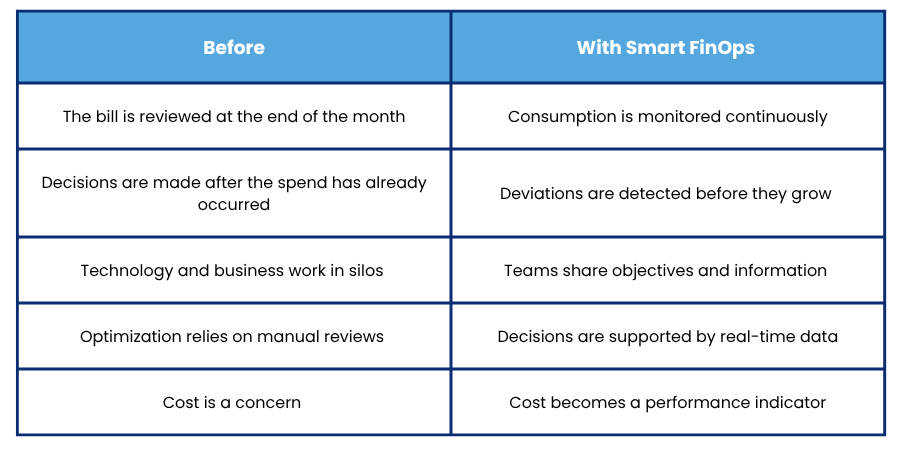
What changes when you apply a FinOps approach
When an organization adopts a FinOps strategy, it changes the way cloud infrastructure is managed.
It’s no longer just about how much servers and the cloud cost—it’s about how they’re being used.
Artificial intelligence is also transforming FinOps
Managing cloud spend manually is becoming increasingly complex.
Infrastructures change constantly and generate enormous amounts of data.
Artificial intelligence makes it possible to analyze that volume of data continuously, detecting behaviors that would otherwise go unnoticed.
- For example, it can help identify:
- Unusual consumption spikes
- Underutilized resources
- Repetitive usage patterns
- Actual scaling requirements
- Optimization opportunities before cost overruns appear
This enables a shift from reactive management to a much more preventive—and even predictive—approach.
A simple example
Imagine a company launching a new application.
During the first few weeks, everything runs smoothly, but when they review the cloud bill, they discover a 35% increase compared to the previous month.
Without a FinOps strategy, the team will have to manually review hundreds of resources to try to figure out what happened and where that increase is coming from.
With a data-driven approach, the analysis quickly identifies that several testing environments are still active outside working hours and that some instances are provisioned well above their actual utilization.
The problem is no longer finding the spend—it’s making the right decision to optimize it.
How Lessthan3 can help
At Lessthan3, we help companies manage their cloud infrastructures and environments more efficiently through advanced FinOps, observability, and AI capabilities.
Our platform continuously analyzes metrics, logs, traces, and consumption data to detect usage patterns, identify underutilized resources, and provide actionable insights to optimize spending without compromising performance.
The goal isn’t just to reduce costs—it’s to ensure that every infrastructure decision is backed by data and aligned with the real needs of the business. So that our clients’ infrastructure and cloud environments enable them to compete in a way that sets them apart.
Conclusion
Cloud spend growth isn’t always the result of increased activity. In many cases, it’s driven by small inefficiencies that go unnoticed and accumulate over time.
That’s why FinOps is no longer just about controlling the budget—it’s about understanding how your infrastructure behaves and using that information to make better decisions.
With the support of Lessthan3’s platform, companies can transform cloud spending into a much smarter, more efficient process that’s aligned with their business objectives.
Because optimizing the cloud doesn’t mean spending less at any cost. It means investing better.