Infrastructure as Code (IaC): how to reduce errors and improve cloud efficiency
Automating infrastructure is no longer an option for many companies; it is the safest way to scale without losing control
A few years ago, deploying infrastructure was a largely manual process. Creating servers, configuring networks, assigning permissions, or deploying environments required a large number of repetitive tasks and relied heavily on the intervention of technical roles (obviously, humans).
As cloud environments have grown in complexity, this model has begun to show its limitations. Every manual change increases the risk of errors, hinders standardization, complicates management, and makes it more expensive as infrastructure grows.
This is where Infrastructure as Code (IaC) comes into play—a practice that allows you to define and manage infrastructure through code in an automated, reproducible, and much more efficient way.
Today, IaC has become one of the pillars of modern cloud operations for any DevOps team, helping companies deploy faster, reduce errors, and improve cloud efficiency.
What is Infrastructure as Code (IaC)?
Infrastructure as Code (IaC) is a methodology that enables you to manage and provision infrastructure using code instead of doing it manually.
Instead of creating resources one by one from a console, teams define servers, networks, databases, permissions, and load balancers using configuration files that can be stored, versioned, and reused.
In other words, infrastructure is managed just like an application.
This provides significant advantages:
- Deployment automation
- Repeatability of configurations
- Greater consistency across environments
- Less reliance on manual processes
- Faster infrastructure scaling
The problem with manual configurations
Many organizations still manage part of their infrastructure through manual configurations and changes made directly to environments.
While this can work when the infrastructure is small, the problem appears when the number of services, teams, and environments begins to grow.
This is when situations arise such as:
- Different configurations between development and production
- Changes that are not documented
- Errors from technical staff during deployments
- Difficulty replicating environments
- Dependence on individual knowledge of specific roles
The result is usually an infrastructure that is harder to maintain, less predictable, and carries greater operational risks.
How IaC helps reduce errors
One of the main benefits of IaC is that it helps reduce errors by eliminating much of the variability associated with manual processes.
When infrastructure is defined through code:
- All deployments follow the same rules
- Changes can be reviewed before being applied
- There is an accessible and complete history of modifications
- Environments are consistent with each other
- It is possible to revert changes more easily
Before vs. After implementing IaC
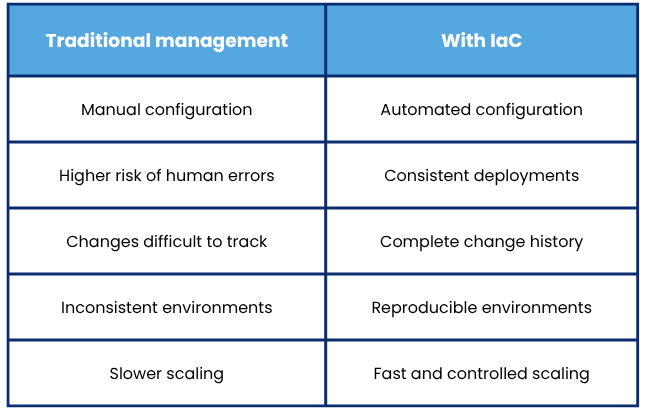
The main advantage of IaC is that it turns infrastructure into a predictable, repeatable, and controlled process.
More efficiency, less time spent on repetitive tasks
In addition to reducing errors, IaC frees up time for technical teams.
Many tasks that used to require hours of manual work can be executed automatically in minutes.
For example:
- Creating new environments
- Replicating configurations
- Deploying cloud resources
- Applying infrastructure changes
- Recovering environments after incidents
This allows teams to spend less time on operational tasks and more time on higher-value business activities.
IaC and observability: an increasingly important combination
Automating infrastructure is a great step forward, but it does not eliminate the need to understand what is happening inside it.
In fact, the more automated and dynamic cloud environments become, the more important it is to have observability.
An infrastructure can be deployed perfectly and still suffer from performance issues, unexpected dependencies, or anomalous consumption.
That is why more and more organizations are combining Infrastructure as Code with observability platforms that allow them to maintain control over constantly evolving environments.
How Lessthan3 helps
At Lessthan3, we help companies operate complex cloud infrastructures with greater visibility and foresight.
Our platform allows you to analyze metrics, logs, and traces in real time to understand how systems are behaving, detect anomalies, and act before problems impact the business.
In environments where IaC accelerates change and scalability, having a complete view of the infrastructure is key to maintaining stability, performance, and operational control.
Conclusion
Infrastructure as Code is no longer a practice reserved for large technology organizations. It has become an essential tool for any company that wants to manage cloud environments efficiently, scalably, and securely.
Reducing errors, accelerating deployments, and maintaining consistency across environments are just some of its benefits.
And when combined with advanced observability, organizations not only automate their infrastructure but also gain a better understanding of it and can anticipate issues.
Because in an increasingly dynamic cloud environment, automation is important. But maintaining control is essential for a modern business to compete on a level playing field in its sector.