AIOps for Cloud Operations: The Future of Cloud Infrastructure Management
How artificial intelligence is helping companies manage complex cloud environments more efficiently, predictively, and automatically
Today’s cloud infrastructures look nothing like they did just a few years ago.
Companies now work with distributed architectures, multi-cloud providers, microservices, and massive volumes of real-time data.
The problem is that while technological complexity grows, many teams are still managing operations much the same way they always have: manually reviewing alerts, jumping between tools, and reacting only after a problem has already caused an impact.
And that’s where bottlenecks begin.
Thousands of alerts per day, incidents that are hard to correlate, issues that take too long to understand, and teams overwhelmed, trying to separate important signals from mere operational noise.
This is where AIOps comes in—an approach that combines observability, automation, and artificial intelligence to transform how modern infrastructures are operated.
Because today, the challenge is no longer just about monitoring systems.
The challenge is understanding what’s happening in real time and acting before the problem escalates.
What is AIOps?
AIOps (Artificial Intelligence for IT Operations) is the application of AI and machine learning to IT operations.
Its goal is to automatically analyze data generated by cloud infrastructures, applications, and services to detect anomalies, correlate events, and help teams make faster, better-informed decisions.
AIOps primarily works with observability data such as:
- Metrics
- Logs
- Traces
- System events
- Monitoring alerts
The key difference is that traditional monitoring shows you data—AIOps helps you interpret it and turn it into action.
The current problem: too much data, too little context
One of the biggest challenges in modern cloud operations isn’t a lack of information—it’s the opposite.
Companies generate enormous amounts of data constantly, but that data is often scattered across different tools and teams.
The result is usually a lot of noise, duplicate alerts, slow diagnostics, incidents that escalate before being understood, and teams working under constant pressure.
And the more the infrastructure grows, the harder it becomes to maintain control.
How AIOps works in cloud environments
AIOps collects data from different parts of the infrastructure—metrics, logs, traces, and alerts—and analyzes it in real time using AI and machine learning.
From that analysis, it can detect anomalies, correlate related events, and identify behavioral patterns that would be extremely difficult to spot manually in modern cloud environments.
This helps reduce operational noise, identify root causes faster, and anticipate incidents before they impact the end user.
The result is a much more efficient, automated, and predictive cloud operation, where teams can make decisions with more context, less noise, and a much clearer view of what’s happening.
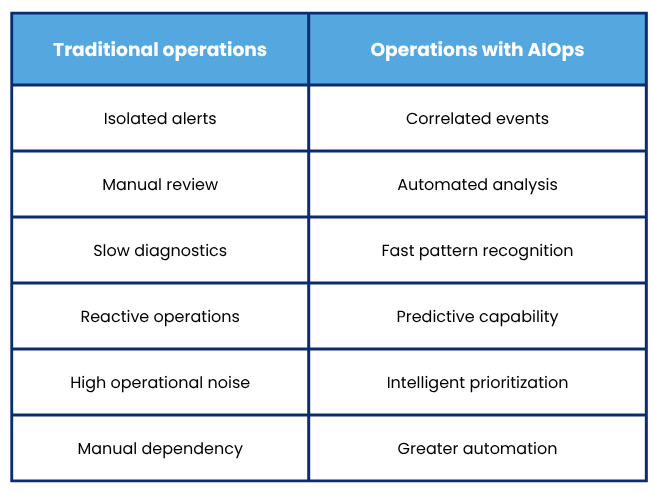
Benefits of AIOps for businesses
Beyond the technical side, AIOps has a very direct impact on daily operations and the business itself.
- Less operational noise: One of the most common issues in IT teams is alert fatigue. AIOps helps correlate related events and reduce unnecessary alerts so teams can focus on what really matters.
- Faster incident detection: AI can identify anomalies before they turn into critical failures, dramatically reducing the time needed to detect and diagnose problems.
- Better foresight: Instead of waiting for something to break, AIOps helps detect patterns that indicate potential future incidents, shifting operations from reactive to preventive—and even predictive.
- Cloud resource optimization: AIOps analyzes how cloud resources are actually being used, helping identify underutilized resources, unnecessary scaling, anomalous consumption, and optimization opportunities—all without compromising performance.
A simple example
Imagine an e-commerce site during a high-traffic sales campaign.
Suddenly, the website slows down, response times increase, many alerts fire, some services stop responding, and the customer experience worsens.
Without AIOps, the team starts manually checking dashboards, logs, and metrics, trying to find the root cause.
With AIOps, the system automatically correlates events, detects that the root cause comes from a specific service, and prioritizes the incident based on its impact.
How Lessthan3 helps
At Lessthan3, we help companies evolve the way they operate their cloud infrastructures through advanced observability and AI-powered predictive capabilities.
Our platform analyzes metrics, logs, traces, and system behavior in real time to detect anomalies, correlate events, and provide useful context from the very first moment.
The goal isn’t just to monitor systems—it’s to turn cloud operations into a much smarter, more efficient, and proactive process.
Because the more complex your systems become, the more important it is to have intelligent operations.
Conclusion
The complexity of modern cloud infrastructures makes it increasingly difficult to manage operations manually.
As systems generate more data and architectures evolve, companies need tools that can interpret that information and act quickly.
AIOps represents exactly that shift: a smarter way to operate cloud infrastructures by combining observability, automation, and artificial intelligence.
With platforms like Lessthan3, companies can analyze metrics, logs, and traces in real time, reduce operational noise, detect anomalies earlier, and make decisions with far more context.
Let me know if you’d like a shortened version for a newsletter or a more SEO-friendly title.