AI-Powered Observability: anticipate problems before they occur
Transform your IT system data into proactive decisions and improve the efficiency, security, and stability of your infrastructure.
For years, traditional monitoring has been the go-to tool for supervising IT systems: CPU charts, disk-full alerts, or pings warning of outages. However, in multi-cloud, distributed, and increasingly automated environments, these approaches are no longer sufficient. Observability powered by Artificial Intelligence (AI) mechanisms is emerging as a natural evolution: it not only detects errors but predicts them, contextualizes them, and suggests solutions before they impact the business.
What is observability and how it differs from monitoring?
Observability is the ability to understand the internal state of a complex system from the data it generates: logs, metrics, traces. While monitoring answers “what happened,” observability seeks to answer “why” and “how to prevent it,” offering a complete and proactive view of the entire IT ecosystem.

The Role of Artificial Intelligence in Observability
AI enhances observability by enabling:
- Real-time anomaly detection in multi-cloud, hybrid, and distributed systems
- Correlation of events across systems, applications, and tools
- Reduction of false positives by understanding the root cause
- Automatic suggestion of corrective actions
- Visualization of large data volumes without losing context
Thanks to techniques like supervised machine learning, clustering, or time series analysis, algorithms can predict failures before they impact end-users, visualizing massive data volumes while maintaining context.
Real-Time Anomaly Detection
A practical example is detecting sudden changes in a service’s behavior:
- Latency increasing by 300% compared to historical values
- Unusual CPU or memory usage
- Drops in requests from specific regions.
If these signals are interpreted in time, it’s possible to prevent outages or detect ongoing cyberattacks. In this sense, AI-powered observability acts as the central nervous system of your IT infrastructure, anticipating problems before they affect the company.
How to Interpret Complex Data with AI
The true complexity lies not only in the volume of data but in its relationships. AI helps to:
- Identify the root component or original cause of a failure.
- Detect correlations between events, e.g., a latency spike and a code update or deployment.
- Determine which users or regions are affected.
- Recognize common patterns from past incidents.
With this information, teams can reduce Mean Time to Resolution (MTTR) and minimize costs associated with incident response.
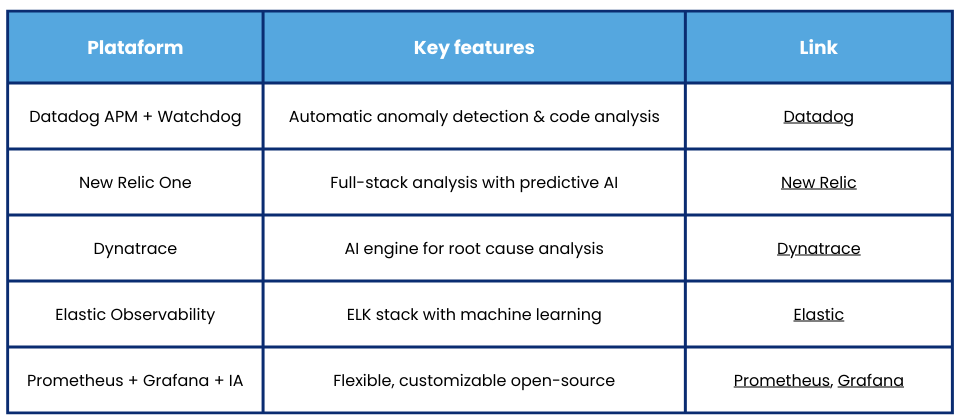
Leading platforms in intelligent observability
Application in companies with critical infrastructure
Sectors like fintech, insurtech, e-commerce, healthcare, and telecommunications cannot afford seconds of downtime. In these cases, AI-powered observability enables:
- Preventing incidents before they occur.
- Prioritizing critical alerts.
- Automatically documenting each incident.
- Learning from every failure and improving processes.
In environments where every second counts, this approach reduces business risks, optimizes application and platform performance.
Conclusion: A new standard in IT control
AI-powered observability is not just an improvement, it’s a qualitative leap. It turns data into decisions, prevents errors before they happen, and allows IT teams to focus on what matters.
At Lessthan3, we help companies to:
- Choose the right tools for your infrastructure.
- Integrate observability into your DevOps processes.
- Design intelligent and actionable dashboards.
- Train your teams in DataOps culture.