FinOps: Transforming cloud spending into a competitive advantage
Cost optimization, financial visibility, and governance for growth without waste
The cloud has revolutionized how companies manage their technological infrastructure, offering scalability, flexibility, speed for innovation, and reduced technical and knowledge barriers. However, it has also introduced a significant challenge for modern businesses: uncontrolled cloud cost.
Many organizations migrate to the cloud seeking immediate savings, only to face rising bills, inflated budgets, and difficulties understanding where every euro is being spent.
This challenge has made FinOps a key discipline for any company wanting to leverage the cloud without losing financial control of its infrastructure.
What is FinOps?
FinOps, short for “Financial Operations,” emerged as a response to the complexity and dynamism of cloud spending. Unlike traditional cost-control models—centralized, static, and based on annual budgets designed for traditional systems —FinOps promotes continuous collaboration between finance, technology, and operations to align cloud spending and investment with business objectives.
In short: FinOps aims to transform the cloud from an unpredictable, variable cost into a measurable, understandable, and optimizable asset.
FinOps: More than savings, a governance discipline
FinOps is not just about “saving money.” It is a practice that combines organizational culture, real-time data, and intelligent decisions to turn investment into efficiency and growth. Simply put: It’s not just about spending less, but about spending smarter and leveraging that investment to drive business forward.
Core principles of FinOps:
The FinOps discipline is built on three phases that enable effective cloud financial management:
- Inform: Create real-time, understandable cloud cost visibility across the entire company. This prevents billing surprises and encourages informed decision-making from day one.
- Optimize: Identify real opportunities for savings and efficiency, such as shutting down inactive resources or leveraging reserved instances for occasional use.
- Operate: Implement continuous governance practices and policies to prevent unnecessary costs in the future. This ongoing approach is what sets FinOps apart from one-time optimization models.
These principles focus on cross-departmental collaboration and shared cost visibility, rather than relegating financial management solely to the finance department, which lacks full context of all technical operations and projects.
FinOps vs. traditional IT management models
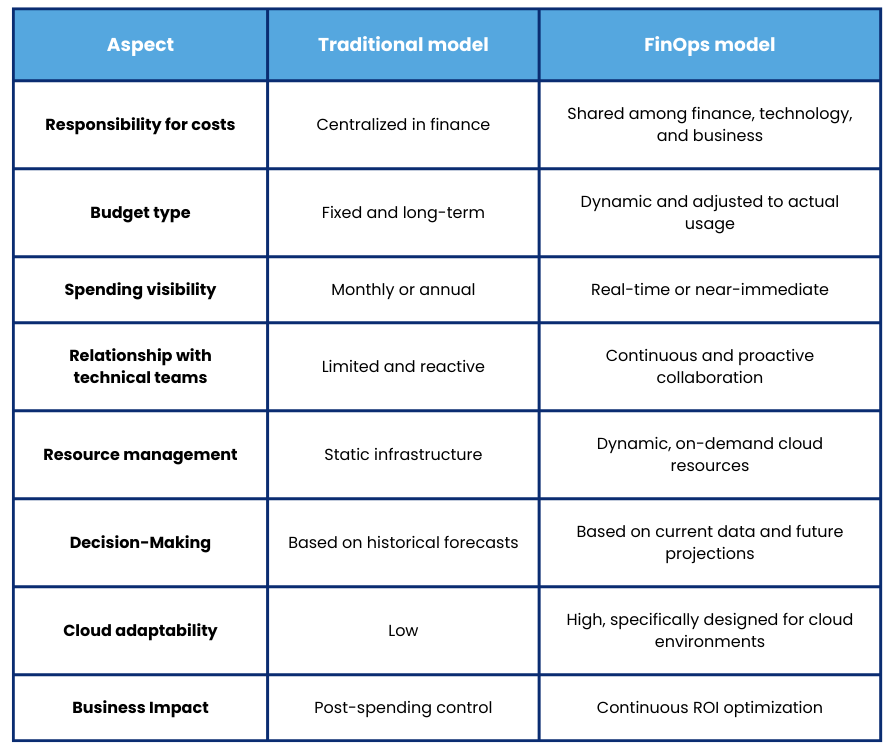
For years, IT spending management has been based on models designed for static infrastructures: annual budgets, centralized control from finance, and limited interaction with technical teams.
The problem is that the cloud doesn’t work that way. Resources are created and destroyed in seconds, costs fluctuate constantly, and every technical decision has an immediate financial impact.
This is where FinOps makes a difference. Instead of a rigid, centralized model, FinOps proposes dynamic, collaborative, and real-time data-driven management.
While traditional approaches rely on fixed budgets and periodic reviews, FinOps works with variable costs, continuous visibility, and shared responsibility among finance, technology, and operations.
This makes FinOps a more agile model, aligned with the reality of the cloud for modern businesses, where every second of usage counts and every technical decision has a direct financial impact.
How FinOps is implemented in practice
Implementing FinOps combines data analysis, a culture of collaboration, and automation principles. It’s not just about technology -it’s an organizational change.
- Audit and visibility of current costs: Before optimizing, you must understand. This involves centralizing cloud usage information, identifying underutilized or wasted resources, and establishing clear metrics and real-time dashboards.
- Cross-Functional FinOps teams: A typical FinOps team includes finance, cloud engineering, and operations profiles. Their mission is to measure, analyze, and act on spending with shared criteria and responsibility.
- KPIs and essential metrics: FinOps metrics help translate data into actionable decisions.
- Automation and alerts: Automation is key to FinOps-detecting anomalies, scaling resources based on demand, or turning instances on/off based on usage reduces manual effort and unnecessary spending.
- Culture of Shared Responsibility: FinOps requires technical teams to understand the financial impact of their decisions, fostering a culture of smart savings aligned with business goals.
Tools that support FinOps
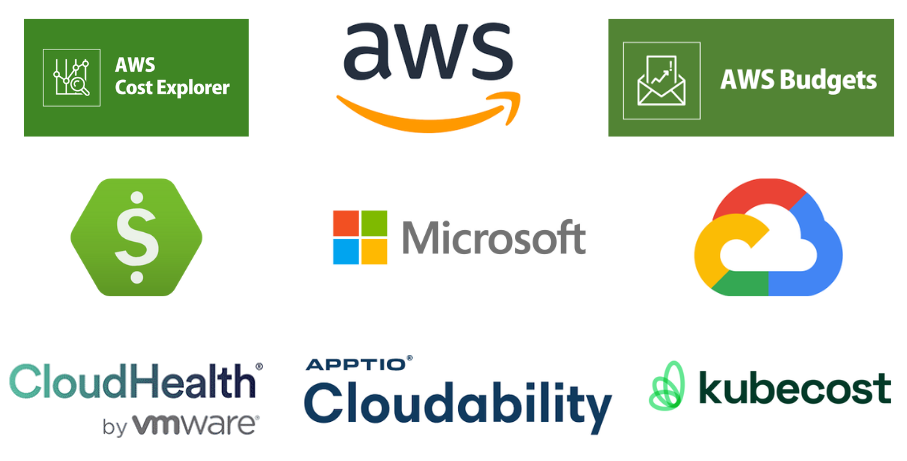
The FinOps ecosystem offers multiple solutions for visualizing, segmenting, and optimizing costs:
- AWS Cost Explorer / AWS Budgets: native visibility in Amazon Web Services.
- Azure Cost Management: Microsoft’s proprietary tool.
- Google Cloud Billing Reports: advanced reports for projects and teams.
- CloudHealth by VMware: multi-cloud aggregator with analytics and alerts.
- Apptio Cloudability: one of the most popular platforms for FinOps.
- Kubecost: visibility into spending in Kubernetes environments.
These tools not only provide numbers, but help you understand and act on them.
Direct benefits of adopting FinOps
- Significant cloud cost savings: mature FinOps companies can reduce cloud spending by 25% to 35%, especially when combining discipline and automation. This data comes from our own experience working with companies of various sizes, geographies, and industries.
- Improved technological ROI: integrating FinOps into cloud strategy enables companies to maximize return on investment by aligning spending with real business value.
- Financial visibility and control: FinOps transforms opaque expenses into clear data that can be interpreted and used by all areas, from finance to developers and DevOps teams.
- Reduced waste: identifying underutilized or oversized resources translates into fewer unnecessary costs and a more efficient cloud.
Real success story: FinOps optimization in an energy sector company
An energy sector company operating 100% on AWS faced continuously growing cloud costs and a lack of visibility into actual resource consumption. After applying a FinOps approach, automated tagging, off-hours shutdown policies, and strategic use of reserved instances were implemented.
Thanks to these actions, the company reduced its cloud costs by 35%, while improving financial control and the operational efficiency of its infrastructure.
Conclusion: how to start applying FinOps with Lessthan3
FinOps is no longer a trend- it’s a necessary response to the financial complexity of the cloud. This discipline turns spending into a competitive advantage, not only by reducing costs, but also by improving governance, visibility, and data-driven decisions-making.
At Lessthan3, we accompany companies at every step of their FinOps journey, from initial spending audits to full policy automation and team training, fostering a solid, shared financial culture- all powered by our AI-driven predictive observability platform.