AI-Powered Observability Platforms: shifting from reactive monitoring to predictive control in 2026
The next generation of Observability for cloud, data, and AI infrastructures
For years, monitoring infrastructure meant collecting metrics, setting up alert systems, and reacting when something failed. That approach worked while systems were relatively simple.
Today’s technological landscape is very different. Distributed architectures, microservices, Kubernetes, AI workloads, data pipelines, and multi-cloud environments have multiplied the operational complexity for systems administration teams. In this scenario, traditional monitoring is no longer enough.
Companies no longer just need to know what failed, but why, what impact it will have on the overall business, what will happen next, and what decision to make before the problem reaches the end customer or affects their experience.
That’s why AI-powered Observability platforms have recently become a strategic pillar for technological resilience, efficiency, and scalability.
In this article, we explore:
- What sets a modern AI-powered Observability platform apart
- What the leading market solutions are offering
- What trends will define the coming years in this niche
- And how Lessthan3 approaches Observability from a unified vision: DevOps methodologies based on FinOps, SecOps, and GreenOps principles
Why traditional Observability falls short
Logs, metrics, and alerts are still necessary, but they’re no longer sufficient. The current problem isn’t a lack of data – it’s the excess of it, the speed at which it’s generated, and the difficulty of interpreting it in context.
In complex environments: alerts multiply without clear prioritization, teams waste time correlating events, problems are detected late, and many decisions remain reactive.
This is where AI applied to observability makes the difference – not as a superficial layer, but as a continuous analysis engine, capable of learning the normal behavior of the system and anticipating relevant deviations. An AI-powered observability platform enables:
- Automatic anomaly detection without relying on manual threshold.
- Complex event correlation across services, infrastructure, and business
- Dramatically reducing alert noise by prioritizing real impact
- Predicting incidents before they occur and affect the business
- Recommending concrete actions, not just displaying data
The result is clear: less time firefighting and more time delivering value.
The AI observability market: where we’re headed
The growth of these platforms makes perfect sense. It’s directly related to the mass adoption of cloud environments, container-based architectures, AI components projects, and distributed architectures.
Some key data points driving the trend:
- The global observability market was valued at around $2.9 billion in 2025 and is expected to exceed $6.1 billion by 2030, with a growth rate of nearly 16% annually, driven primarily by solutions with AI and automation capabilities.
- Over 50% of companies already use AI-based observability capabilities, especially to reduce MTTR and improve operational reliability.
- Analysts agree that observability will evolve toward predictive and automated systems, integrated with business, security, and sustainability decisions.
The conclusion is clear: observability has moved beyond being a technical tool to become a competitive advantage – one that is no longer relevant only to the CIO, CTO, or technologists.
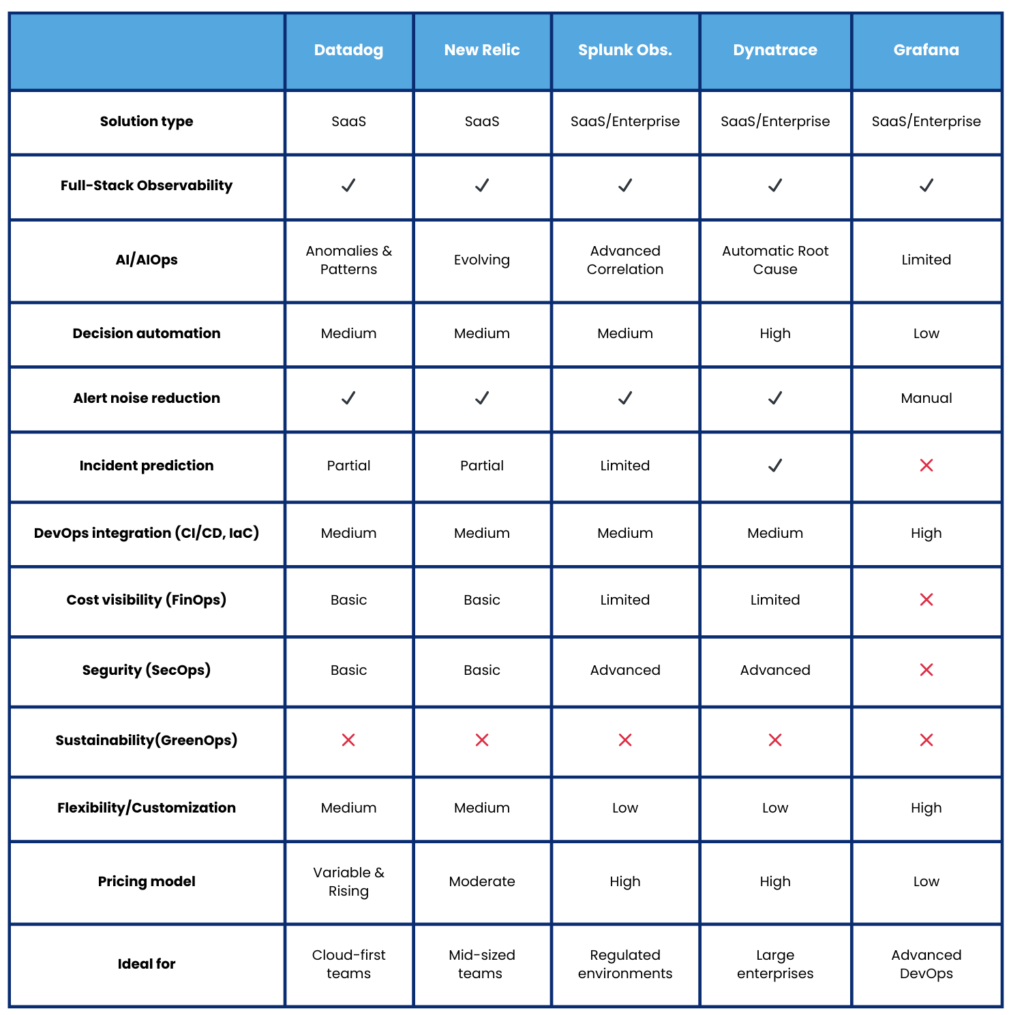
2026 Comparison: leading market platforms
Today, there are well-established solutions, each with different approaches and capabilities.
What makes us different
At Lessthan3, we start from a clear premise: observability shouldn’t be just a technical tool – it must be actionable by more roles, have predictive capabilities, and align with business priorities and requirements.
Our predictive AI-powered observability platform is born from years of experience providing DevOps services and evolves into a product that integrates development, operations, costs, security, and sustainability into a single approach.
DevOps: observability applied to the software lifecycle
We integrate metrics, traces, and events directly with CI/CD practices and Infrastructure as Code (IaC). This enables:
- Faster, more reliable deployments
- Fewer human errors
- Consistency across environments
- Greater visibility from code to production
FinOps: real cost visibility
Our FinOps module helps understand, optimize, and predict cloud spending:
- Identification of underutilized resources
- Automated scaling
- Analysis of pricing models across different cloud providers
- ROI optimization without sacrificing performance
SecOps: integrated security
- Security isn’t separate – it’s part of the system:
- Real-time threat detection
- Vulnerability assessments
- Access management and compliance
- Integration with DevSecOps practices
GreenOps: Measurable sustainability
We measure the digital carbon footprint of your cloud services:
- Detailed environmental impact reports
- Identification of energy inefficiencies
- Practical recommendations for reduce emissions
- Integration with more efficient pipelines
All of this is powered by various AI models that don’t just observe – they learn, anticipate, and choose the best algorithmic approach for each type of architecture.
Conclusion
In 2026, observability is no longer about looking at the past – it’s about anticipating the future.
AI-powered platforms make the difference between reacting late and getting ahead. Choosing well doesn’t just depend on the tool itself, but on how it integrates into your way of working, deciding, and scaling.
At Lessthan3, we’re building a platform designed for exactly that: predictive control, real efficiency and technology aligned with business and the planet.