GreenOps: How to reduce your digital carbon footprint without slowing innovation
Sustainability and efficiency in cloud infrastructures
Massive digitization has pushed companies to unprecedented levels of efficiency and speed of change, but it has also generated something we often ignore: a growing environmental footprint.
There are data centers that consume more energy than entire countries, and every line of code deployed, every function executed, and every file stored carries an energy cost that seems invisible. At a time when sustainability is no longer optional -driven by principles, regulations, and even end consumers – an inevitable question arises:
Can we reduce our digital footprint without sacrificing performance, agility, or innovation?
The answer is yes, and this approach in the tech world is called GreenOps.
What is GreenOps really is
GreenOps (Green Operations) is a natural evolution at the intersection of DevOps (efficient software development) and FinOps (DevOps with financial principles), incorporating a key dimension: technological sustainability. Its purpose is to manage infrastructure more efficiently, responsibly, and with awareness of its environmental impact.
It’s not just about saving energy, but about making technology decisions aligned with a sustainable model – from how we deploy environments and manage storage, to which cloud regions we choose and how we measure consumption.
More and more companies are adopting it not only as an ethical commitment but as a competitive advantage: less waste, more optimization, greater efficiency.
Why GreenOps matters now (more than ever)
We live in a moment where digital sustainability is becoming a global priority. Some facts speak for themselves:
- The digital sector already accounts for 2% to 4% of global CO₂ emissions, and could double by 2040 if no action is taken.
- Data centers consume as much energy as entire countries, driven by the growth of cloud, big data, and AI.
- The indirect emissions (Scope 3) of tech giants have increased by 150% in just three years, due to the boom in AI models and constant training.
- Legislation is starting to demand digital environmental transparency. The European Corporate Sustainability Reporting Directive (CSRD) requires companies to report on their environmental impact, including their digital aspect, and demonstrate actions to reduce their technological footprint.
In this context, GreenOps is no longer a vision of the future but a standard for businesses that want to grow and become more profitable without increasing their footprint – while maintaining competitiveness.
How to apply GreenOps without complicating your day-to-day
Adopting GreenOps principles doesn’t mean reinventing your entire infrastructure management, but rather starting to make smarter strategic and tactical decisions while measuring what once seemed invisible.
Reduce idle computational or storage environments, optimize oversized instances or machines, store only what’s necessary, choose cloud regions powered by clean energy, or visualize the energy consumption associated with each workload to stay aware of what’s happening.
Thanks to this, we can now measure what was once intangible: emissions from cloud services used, understanding the truly necessary energy consumption, or discarding and deactivating inefficient resources.
GreenOps within the Lessthan3 platform
At Lessthan3, we have integrated a GreenOps module as a key tool in our predictive AI-powered observability platform, which also complements FinOps principles. It’s not an add-on: it’s an essential part of how we understand and maximize technology responsibly.
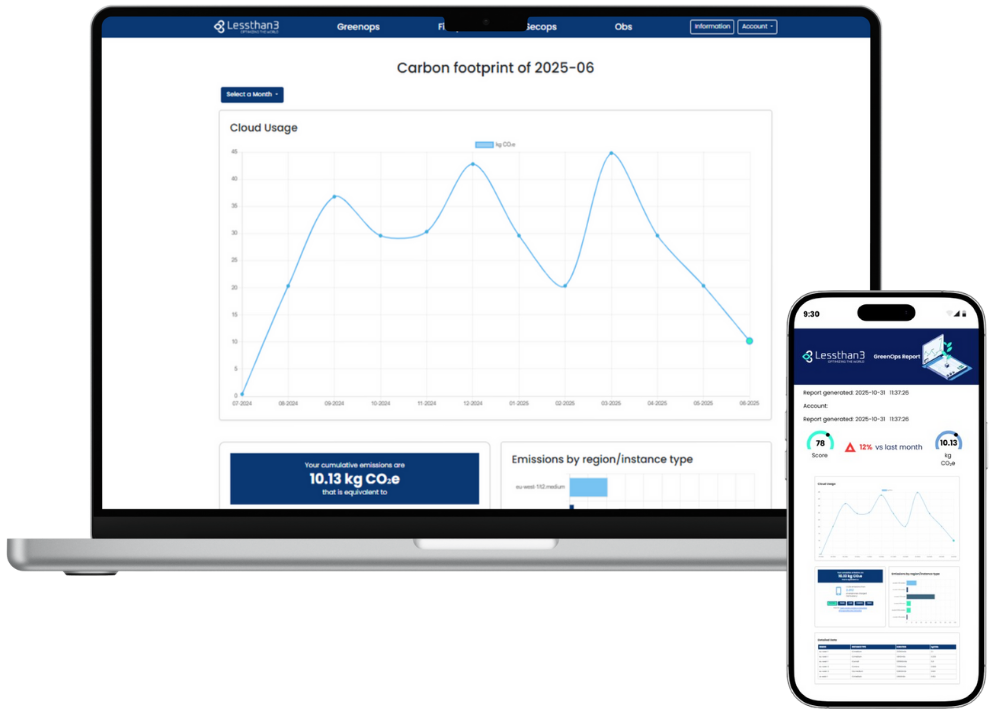
Our approach combines analysis, optimization, precise measurement, and predictive intelligence to help you make informed decisions from day one.
Here’s what we do for your company:
- Measure your real carbon footprint. Detailed report on the environmental impact of your cloud services, along with clear, actionable recommendations.
- Otimize your infrastructure with sustainable criteria. From cloud resource usage to more energy-efficient CI/CD pipelines.
- Automatically detect inefficiencies. Our monitoring tools identify unnecessary consumption, oversized loads, and patterns that increase your energy expenditure.
- Help your team incorporate sustainability into their daily work. Training, guides, and best practices so your technology decisions are more conscious without sacrificing speed or performance. Because we believe the best code is no longer just the one that works fast and securely, but the one that is aware of its impact on the environment and the planet.
Real case: applied sustainability
A SaaS company with thousands of monthly users contacted us after observing accelerated growth in their cloud costs. In addition to applying FinOps measures, we analyzed their infrastructure from a GreenOps perspective. The results?
- 24% reduction in energy consumption in 6 months
- Switch to a cloud region powered by hydroelectric plants
- Automated nightly shutdown system for staging environments
And the best part: sustainability became a new differentiating value for the brand – not just a whim or regulatory compliance.
Conclusion
GreenOps has shown Lessthan3 and our clients that it’s possible to grow, scale, and improve businesses across various industries without increasing environmental impact. Digital sustainability is no longer a brake on innovation but a way to drive and maximize every resource and type of technology.
The question now is simple: Are you ready for your infrastructure to work not only for your clients but also for the planet? With Lessthan3, change is just one decision away.