Observability and DevOps as a Service: grow efficiently without friction
Protect and optimize your infrastructure based on principles profitability and scalability
Introduction: Why DevOps is no longer just internal?
For years, traditional Systems Administration, SysOps, and now DevOps roles were a structural part of any IT department. These engineers were responsible for software continuous integration, deployment automation, system monitoring and security, or focused on the scalability and resilience of the company’s technological infrastructure.
However, the technological landscape has completely changed. The acceleration of software development, the need to scale faster than before, and the growing complexity of modern architectures supporting major data and AI projects have led many organizations to rethink the traditional model.
In a context where agility, specialization, and efficiency are key, outsourcing the improvement and maintenance of technological infrastructure, along with associated DevOps processes, has become an option that makes sense from a business management and financial perspective. The DevOps as a Service (DaaS) model convinces CIOs, CTOs, and CFOs because it provides expert, up-to-date, and multidisciplinary support without the structural cost of hiring staff directly.
In this article, we delve into what adopting DaaS as a partnership model entails, the benefits or added value it provides compared to an in-house team, when it makes sense, and how it can become a sustainable growth engine for any business.
What "DevOps as a Service" means
Translated as DevOps as a Service (DaaS), it is a specialized partnership model where an external team to the organization is responsible for implementing, maintaining, designing, or improving an organization’s DevOps processes. It is tactical support that also complements the strategic vision of key roles like CIOs, CTOs, or even CPOs (Product).
Instead of relying on an internal technical team, you work with a specialized partner, like Lessthan3, which assumes all functions remotely or on-site. This provides the flexibility required by the changing needs of the business, combined with the wealth of learnings an external partner brings from working with numerous companies across many sectors on these types of tasks. The business model followed by advertising agencies—supporting, guiding, and providing a different perspective to the marketing team—is a simile for DaaS but in technological infrastructure tasks.
Among the most common tactical services that occupy the day-to-day are:
- CI/CD automation (Continuous Integration and Continuous Delivery): fast, validated, and error-free deployments.
- Infrastructure as Code (IaC): reproducible, secure, and scalable environments.
- 24/7 monitoring and observability: early detection of failures and bottlenecks.
- Cloud environments scaling (AWS, Azure, GCP): optimal performance and cost control.
- Security and compliance (DevSecOps): Security integrated from the design.
- Resilience and disaster recovery: tested plans and fault-tolerant architectures.
- Continuous support and incident management: Guaranteed response and stable operation.
This outsourcing approach allows companies to focus on growing their business while the provider not only ensures technical solidity, performance, and operational continuity but also maintains a focus on continuous improvement. In this regard, FinOps, SecOps, and GreenOps practices aim to make companies’ cloud or physical infrastructure more efficient, secure, and effective, contributing to the company’s profitability.
Benefits compared to an in-house team
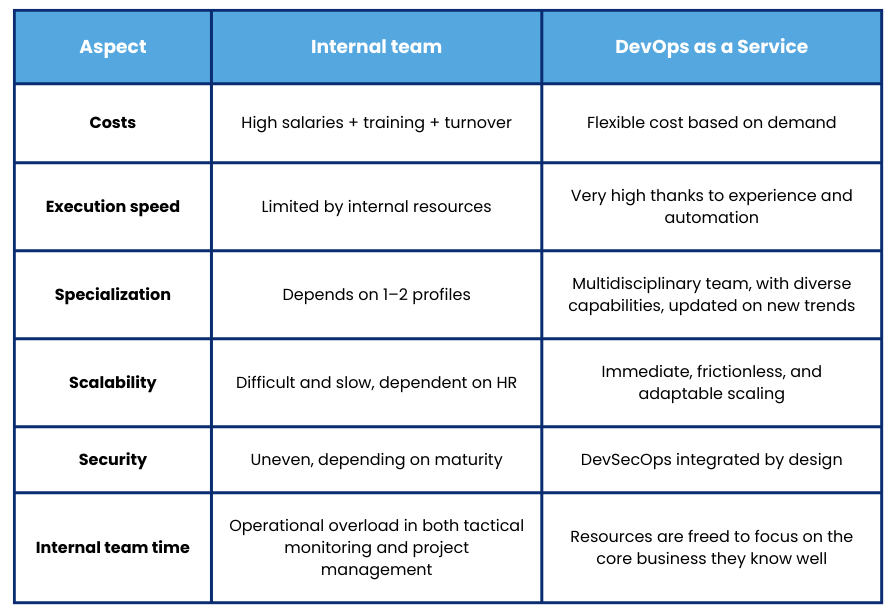
Having a DevOps partner provides competitive advantages that go beyond economic savings:
Ideal use cases
DaaS adds value to different types of organizations but is especially transformative for:
- Tech Startups: they launch more secure and scalable MVPs without overloading the in-house team or slowing down deployment speed or their go-to-market strategy.
- Growing Scaleups: they grow without compromising performance, with a neutral viewpoint that hyperscalers or their partners don’t provide, while optimizing cloud spending.
- Traditional Companies Undergoing Digital Transformation: they accelerate digital transformation and migration to the cloud without needing to create specific teams that won’t be required at such high capacity in the company’s near future.
- Cost Reduction for Mature Companies: they reduce total operational costs by decreasing the number of required in-house profiles, which is even more relevant in large enterprises. They allow maintaining efficiency and quality, leveraging best practices and technical knowledge gathered by the provider across numerous verticals and projects.
What does Lessthan3 bring as a DevOps partner?
In addition to our predictive AI observability platform, at Lessthan3, we specialize in offering a “DevOps as a Service” partnership for organizations seeking agility, stability, and control without needing to expand their staff.
Our value proposition is built on:
- Total Integration between development and software operations. We unify the tasks of technology teams, automate pipelines, and improve flows so software moves from development to production environments quickly and without friction.
- Optimization of cloud spending. We reduce consumption and cloud costs by applying best practices for efficiency, auto-scaling, and continuous spending analysis. We review which services are actually used and for what.
- Neutrality. We are not re-sellers and have no benefit from our clients spending more, making us truly cloud-agnostic and neutral.
- Protection of your infrastructure. We integrate security into every phase with automated scans, access management, audits, and DevSecOps practices that fortify your environment. We start from this principle to avoid future errors.
- Reduction of your carbon footprint. We not only design more efficient and sustainable infrastructures to minimize costs and increase business profitability, but we are also aware of how important it is to minimize energy consumption and emissions without losing performance.
- Deployment and management of AI models. We create environments ready to train, version, deploy, and monitor AI models securely and at scale. Modern infrastructures have higher computational load requirements, and we have experience building solid foundations for the most advanced data and AI projects.
- Improvement of data processes and Business Intelligence (BI). We have experience in data engineering and science to optimize the collection, analysis, and reporting of key information on BI platforms, ensuring decision-making is based on precise, accessible, and updated information.
Success indicators: how to know if your DevOps strategy is working
Measuring the real impact of your investment in DevOps is key. A solid strategy is directly reflected in system stability, delivery speed, and operational efficiency. Here are some key KPIs:
- Deployment frequency
A good DevOps system allows for regular, fearless deployments. If releases are slow or generate errors, something is wrong.
- Mean Time To Recovery (MTTR)
When a failure occurs, the time it takes to recover makes all the difference. With a good DevOps strategy, this time is drastically reduced.
- Number of critical incidents
Prevention, automation, and monitoring decrease serious errors. Fewer incidents are synonymous with greater DevOps maturity.
- Operational cost
With IaC, automation, and cloud resource control, costs should trend toward optimization. If expenses increase without justification, it’s time to review.
- Development team satisfaction
A happy Dev team deploys faster, with higher quality and less frustration. A solid and reliable infrastructure translates to less wasted time.
Conclusion
Outsourcing DevOps is a strategic decision that allows organizations to focus on their own value proposition without neglecting technical stability and scalability.
With DevOps as a Service, companies benefit from the partnership of an expert team, advanced tools, and a flexible, scalable working model.
At Lessthan3, we help ensure your infrastructure stops being an obstacle and becomes your best ally. Grow without friction and without taking unnecessary risks.