Cloud security for SMBs: a practical and updated guide
Protect your SMB without complications: smart decisions and accessible tools
We live in an era where relying on the cloud is essential. From the “simple” email system to billing or customer management platforms, a significant part of a company’s daily operations – whether an SMB or a large enterprise – takes place in digital environments. But is that data truly protected? The answer, in many cases, is not as it should be. The good news is that you don’t need to be a large corporation to have the resources for robust cloud security. All you need is technical knowledge (or a partner who provides it), an awareness of its importance, and smart decisions about your critical assets.
The new risk landscape for SMBs
For years, it was thought that cyberattacks exclusively targeted large companies. However, today SMBs are a favorite target. This happens because they often:
- Lack specialized technical roles (DevOps).
- Underestimate the risks to their business.
- Do not have clear access or protection policies.
Ransomware, phishing, or data breaches can have devastating consequences for an SMB: from customer loss and a damaged reputation due to information exposure, to fines for non-compliance.
Main threats in cloud environments
Among the most frequent risks are:
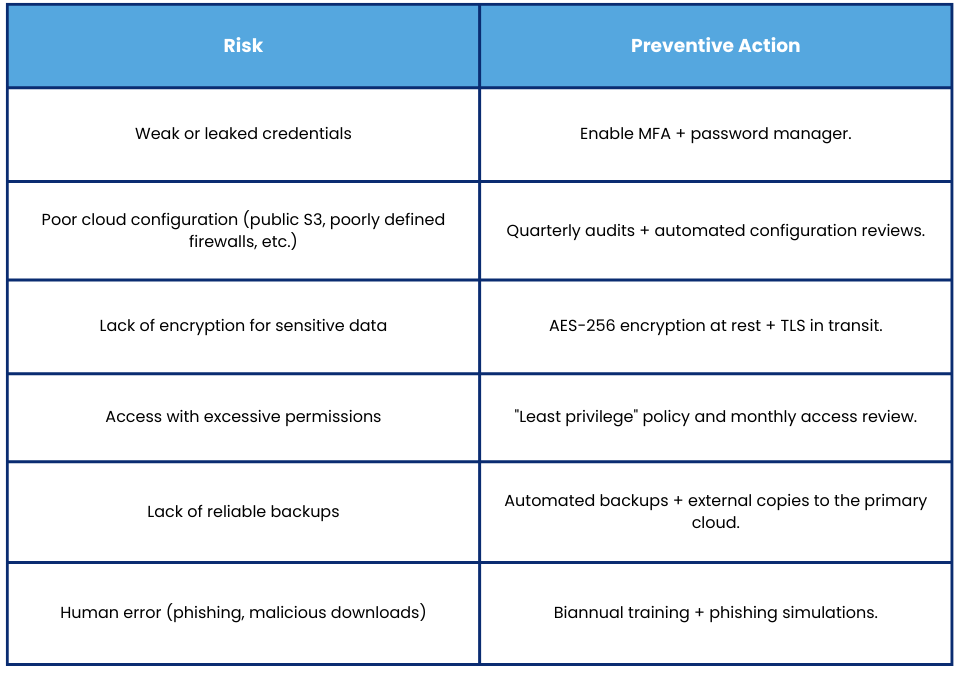
- Leaked or weak credentials. Many SMBs reuse passwords or do not apply password rotation policies.
- Misconfigured cloud services. Public S3 buckets, unencrypted databases, or poorly defined firewall rules are common errors.
- Lack of encryption for sensitive data. Information such as customer data, invoices, or payment histories can be intercepted during transmission or stored insecurely. Encryption in transit (TLS/SSL) and at rest (AES-256) is essential.
- Access without multi-factor authentication (MFA) or poor permission management. 99% of successful account attacks could have been prevented with MFA (Microsoft Security Intelligence, 2023).
- Absence of reliable backups. Without periodic and versioned backups, a ransomware attack can completely paralyze a business. Backups should be automated and stored securely, ideally outside the primary cloud.
Most of these risks can be avoided with good practices.
Security best practices for small and medium businesses
To protect your SMB, consider implementing:
- Multi-factor authentication (MFA) on all access points. A password is not enough; add a second factor (SMS, authenticator app, physical key). This drastically reduces the risk of unauthorized access.
- Regular review of permissions and access. Each employee should only have the permissions strictly necessary for their role. This contains the spread of attacks if an account is compromised.
- Encryption of data at rest and in transit. All sensitive information must be encrypted, even within the cloud itself. This includes emails, databases, and shared files.
- Periodic audits of your cloud service configurations. Reviewing configurations, firewall rules, buckets, and logs helps detect errors before they are exploited. Gartner recommends quarterly audits for medium-sizedSMBs.
- Team training or a reliable security partner. Most attacks start with human error: a click on a phishing link or the download of a malicious file. Semi-annual awareness programs significantly reduce risks .
- A well-defined incident response plan. Having clear procedures to detect, contain, and recover systems ensures an attack doesn’t halt your operations. It should include defined roles, internal and customer communication plans, and backup restoration.
Accessible tools that make a difference
You don’t need to invest large sums to protect your SMB:
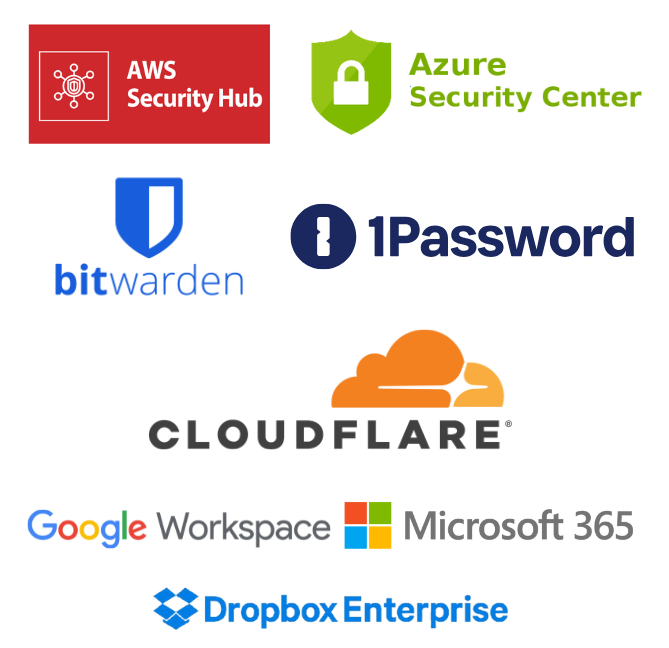
- AWS Security Hub or Azure Security Center: for automated security assessments.
- Bitwarden or 1Password: for secure password management.
- Cloudflare: for website protection.
- Google Workspace or Microsoft 365: with their security controls activated.
- Automated backups with historical versions on services like Dropbox Business or Wasabi.
How Lessthan3 helps
At Lessthan3, we believe cloud security is not a luxury, but a necessity. Our mission is to empower SMB to protect its data effectively, simply, and without unnecessary costs. To achieve this, we partner with companies every step of the way:
- We assess your current risk level to understand how to best support your business and design a tailored roadmap.
- We help you correctly configure your cloud services to maximize the potential of available features and services.
- We automate backups, access, and alerts so our clients are always prepared.
- We train your team using clear language, free of unnecessary jargon, and provide ongoing support.
Our goal is for your SMB to be not only secure but also at ease.
Conclusion
Cloud security is not an option; it’s a priority due to the critical nature of digital assets. And today, more than ever, all businesses, small and large, have tools and partners like Lessthan3 to protect their information without complications or excessive costs.
At Lessthan3, we guide you step by step so your SMB can be agile, leverage technology, and do so securely.