Observability: key to competitiveness

From traditional monitoring to predictive observability

OBSERVABILITY IN SIMPLE BUSINESS JARGON

Observability is a natural evolution of traditional IT monitoring that enables organizations to understand the internal state of their technological systems based on the data they generate (see next section).  While traditional monitoring relies on predefined metrics and specific alerts, Observability provides a deeper and more flexible view, allowing modern companies to diagnose and resolve issues proactively.

And there is a rapidly growing market expansion fueled by the growing need for solutions that help organizations effectively manage and understand increasingly complex IT environments.

BUSINESS MOTIVATIONS AND MARKET SIZE

This is not a “niche need”, the market size was valued at USD 23.62 billion in 2024 and will grow from almost $30 Billion this present year to almost $140 by 2034.

This valuation is fueled by a few obvious triggers that come to mind: An increasing adoption of cloud computing, the need for businesses to improve their operational efficiency while reducing downtimes, the motivation to improve operating financial margins to remain competitive, and the ambition to enhance the overall customer experience.

Organizations are also increasingly focusing on data-driven decision-making (advanced analytics, data science & AI), leading to a greater demand for Observability tools that provide real-time visibility and insights into system/application performance and user behavior.

WHICH DATA DO WE NEED TO LOOK AT?

Which data does Observability pay attention to to be effective?

  • Logs: Detailed records of events within a system, providing information about what happened, when, and why. These records are used for problem analysis, security auditing, and application diagnostics. An example log entry could be as follows: 2025-02-14 12:34:56 ERROR ServiceX – Database connection failed: Timeout
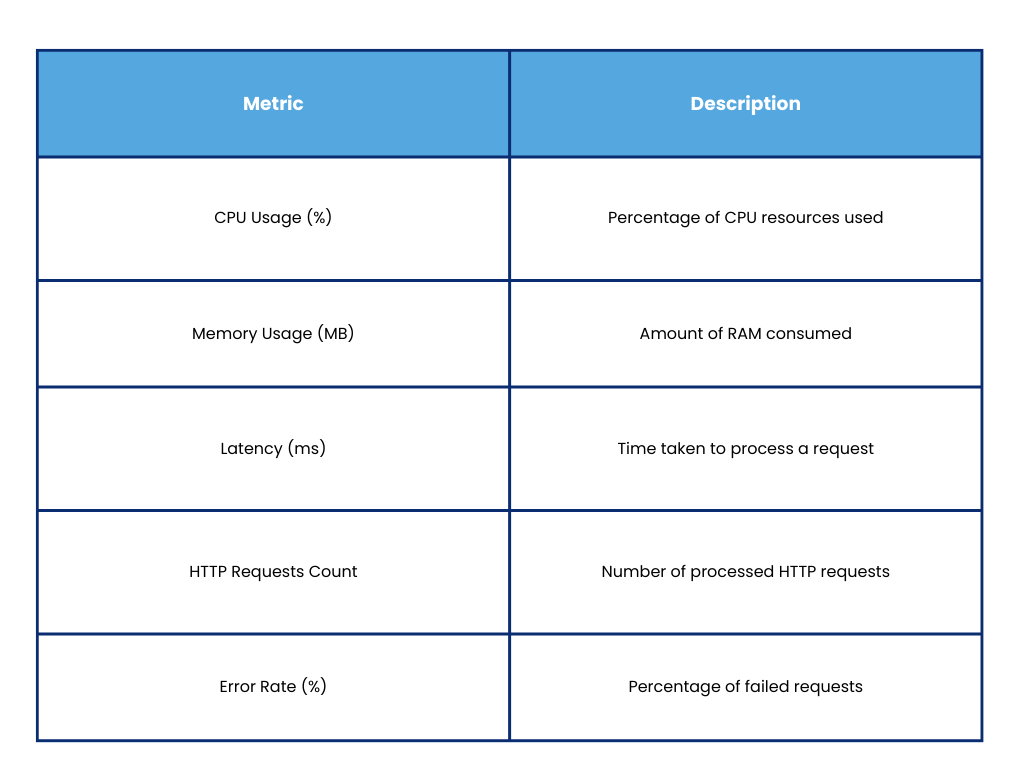
  • Metrics: Numerical data that aims to reflect system performance. Metrics are required during the analysis stage to establish trends and detect anomalies before they impact systems and eventually technical or business users, including data such as the following:
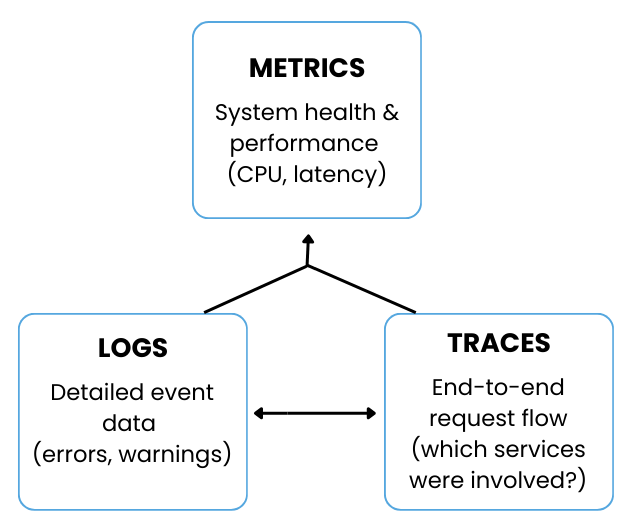
  • Traces: These allow engineers to track the journey of a request through a distributed system, for instance, helping to pinpoint bottlenecks and failure points in modern microservices-based applications. This data is collected using a combination of collection agents, APIs, and real-time data pipelines. Example:

So let´s quickly see how logs, metrics, and traces work together in an Observability context: Logs tell you what happened, metrics show how things are performing over time, and traces reveal where things slow down across systems.
A MUCH-NEEDED EVOLUTION FROM IT MONITORING

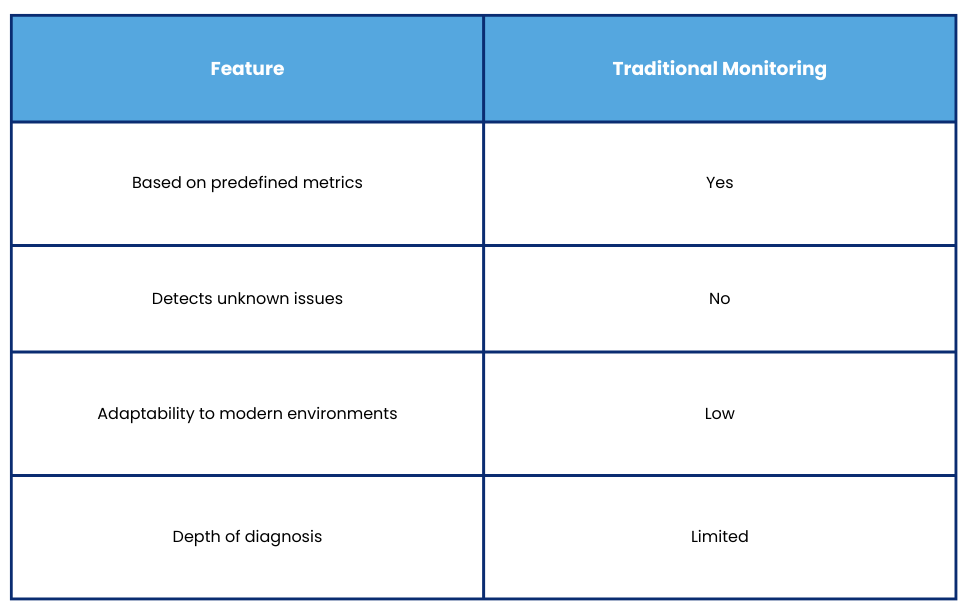
“Classic” monitoring focuses on static alerts and predefined metrics, while Observability enables a deeper system behavior analysis, aiming to discover unforeseen issues. In modern businesses surrounded by dynamic infrastructure environments where microservices and cloud computing are thriving, Observability is essential because systems continuously evolve and require rapid and effective diagnostics. 

The following table  summarises the difference:
OBSERVABILITY IS A NEW NORM FOR ALL BUSINESSES

Just think of different businesses of varying digital maturity, different process complexities, and revenue figures where Observability is crucial at all stages

  • At a VC-backed start-up, it helps smaller teams scale technology infrastructures while maintaining control over performance and costs. 
  • If you lead a Scale-up that is growing, because it has proven to be successful in a market opportunity within a specific niche, Observability helps you to manage the growing complex environments where microservices and distributed architectures. 
  • If you manage a well-established business, you can still enhance operational efficiency and user experience in both legacy and modernized systems. 

Regardless of size, revenue, or industry, it should be part of business budgets due to the following benefits:

  • Reduced downtime and increased resilience: Faster issue detection, resolution, and proactive incident management can help your business prevent significant financial losses from service outages. Paired with DevOps methodologies, it enables detection and addressing of potential issues before they reach production.
  • More efficient operations: It allows teams to analyse infrastructure usage trends so technical experts learn which resources can be optimised to reduce unnecessary expenditures. Moreover, automating problem identification without constant manual intervention aids in reducing technical headcount, too.
  • Improved user experience: Minimises response times and errors in business-critical applications so that end-users are not impacted by delays or slow responses by apps and services.
  • Regulatory compliance and security: Observability supports traceability and detailed records for audits and security.

ON-PREMISE VS CLOUD

This market is categorized by deployment type into (1)on-premises, (2)cloud-based, and (3) hybrid solutions. Among these, the cloud segment will probably dominate, in terms of market share, primarily because of the flexibility, scalability, and cost-efficiency metrics provided by cloud-based solutions, along with the rising adoption of these infrastructures among modern businesses.

The on-premises may maintain steady growth because many enterprises, particularly in the insurance and banking verticals, continue to prioritise data security and compliance, choosing to host Observability tools within their infrastructure. 

Meanwhile, hybrid deployment models (integrating both of the previous) will continue to gain traction as they offer the best of both, the upsides of cloud scalability without compromising on control.

IT IS NOT EASY

Adopting an Observability strategy involves overcoming challenges that require the right expertise. Whether you opt for a SaaS solution with some sort of premium support (a “SaaS on steroids”) or engage a DevOps consulting partner, some assistance is needed. Here’s why I say so:

  • Price Complexity: Solutions often come with high, variable, and difficult-to-understand pricing models. Costs vary based on data ingestion, storage, and retention policies. Yet your CFO will ask for cost predictability same as with cloud expenses,  which often requires expert guidance to choose the right pricing model or optimising data collection and storage strategies
  • Managing data volumes, storage, and processing cost optimization: Observability requires processing a good chunk of logs, metrics, and traces in real-time. This can stress systems, plus without a well-defined retention strategy, you may end up storing redundant or low-value data, leading to unnecessary expenses. Without expertise in data filtering, retention policies, aggregation, normalisation, and compression, teams may be overwhelmed with unnecessary data and skyrocketing costs.
  • Integrations with legacy and cloud systems: Ensuring compatibility with previous infrastructure, cloud providers, and environments is key. Many legacy systems were not designed for modern Observability. This requires manual work, custom connectors, and middleware to bridge gaps. A partner with expertise in integration strategies can significantly accelerate deployment.
  • Culture and formation: This is a cultural shift. Developers and operations teams need training on new tools, methodologies, and best practices. Without it, your teams may underutilize Observability solutions, leading to poor adoption and limited return on investment.

Besides these 4 main reasons, every business has unique operational requirements. Off-the-shelf solutions rarely meet all needs out of the box. 

You may need a partner who can help you with these 4 technical barriers, someone to perform a bit of expert tuning (custom dashboards, alerting mechanisms, etc). Look for a team of DevOps engineers who are knowledgeable in Observability such as the guys at Lessthan3.

MARKET PLAYERS AND SOLUTION LANDSCAPE

There are several technological alternatives built by niche players and major vendors. However, even in environments where these tools are widely used, IT issues are still often addressed reactively. These market solutions generally fall into two broad categories:

  • Log-based and metric-centric monitoring systems. These tools focus on collecting data to measure the health of infrastructure using KPIs. Well-known names in this space include:
    • IBM (Instana)
    • Splunk (ADESCA-Skyline)
    • Datadog (Watchdog)
    • Grafana (Synthetic Monitoring)
    • SigNoz Observability Platform
    • New Relic (Intelligent Observability Platform)


Many of these platforms are reactive by design, although they have started incorporating machine learning features in attempts to reduce MTTI (Mean Time to Identify) and MTTR (Mean Time to Resolution).

  • Proactive and predictive observability systems. This newer category where businesses like lt3.io are at goes beyond metric collection. These platforms apply advanced analytics and ML models to historical and live data to detect patterns and predict potential failures before they happen. Their goal is to move from incident response to prevention, using predictive insights to mitigate risks in real-time.


Interestingly, several of the traditional players from the first group are now evolving towards this second category, adding algorithmic layers to derive new metrics and predictions from existing observability data.

CONCLUSIÓN

Observability with DevOps practices is already transforming how businesses from all industries operate at different digital maturity stages. It directly reduces operating margins and therefore profitability and long-term growth. Moreover, it reduces silos by enhancing visibility across IT assets’ performance and health. 


And what is next? Opportunities lie in the adoption of Artificial Intelligence (AI) to enhance the capabilities of Observability tools: From automated anomaly detection to advanced monitoring and prediction of system failures. I will cover this in the second part of this article about Predictive Observability.